Origin: Kenya
Producer: Mugaga Farmers Cooperative Society
Wet mill: Kagumoini Factory
Region: Karatina, Nyeri County
Varieties: Batian, Ruiru 11, SL-28, SL-34
Process: Washed
Altitude: 1500 - 1700 m.a.s.l.
Flavour Profile: Pear, Hibiscus & Raspberry
Kagumoini Factory is located near Karatina in Nyeri County and is part of the Mugaga FCS, alongside other notable factories such as Kieni, Kiamabara, and Gatina. The cooperative has approximately 5,000 active members, and each wet mill is managed independently with support from a central leadership team.
Since 2013, Mugaga has worked with buyers focused on quality, transparency, and sustainability. The factory provides credit for school fees, emergency expenses, and inputs. CMS (Coffee Management Services) offers continuous training and updates for both factory managers and farmers, with a long-term goal to improve both yields and cup quality.
Harvest
The region’s flowering season occurs from February to March, with the main harvest from October to December. Located at an altitude between 1,500–1,700 meters above sea level, the area benefits from red volcanic Nitisol soils and temperatures ranging from 13°C to 26°C, with about 1,100mm of rainfall annually. Farmers primarily grow SL34 (90%), along with SL28, K7, and Ruiru 11. Each farmer typically cultivates around 250 coffee trees and also grows crops like maize, bananas, and beans.
Post-harvest
Cherries are hand-sorted by farmers before delivery to remove underripe and overripe beans. A 3-disc Agaarde pulping machine removes the skin and pulp, then grades the coffee by density. Grades 1 and 2 proceed to fermentation; Grade 3 is separated as lower quality.
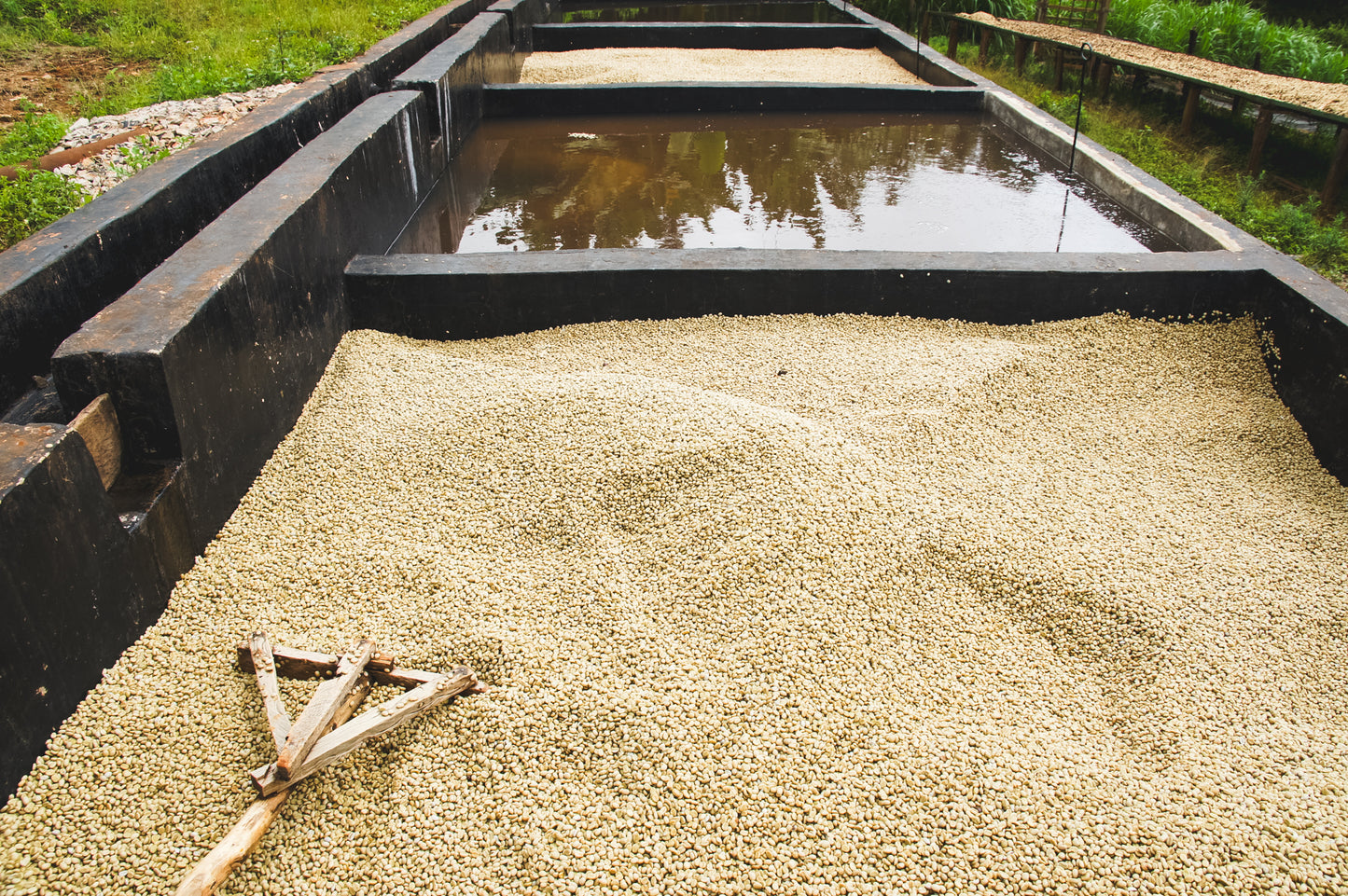
The coffee is dry fermented in concrete tanks for 18–36 hours under a roof to maintain stable temperatures. Some batches undergo intermediate washing every 6–8 hours during fermentation to improve clarity and consistency.
After fermentation, the parchment is washed in channels and graded again by density. The densest beans are soaked in clean water for up to 24 hours to further develop clarity and sweetness.
The coffee is sun-dried on raised African beds for 12–20 days, depending on climate conditions. Beans are covered with plastic during midday heat and overnight to avoid damage. Initial skin drying may occur on hessian mats before transferring to drying tables.